Longlot VisionVision Feasibility Review

Test one visual check before anyone buys a camera.

A camera project should start with a narrow, measurable question, not a promise that computer vision can see everything. This review tests one visible presence/absence check at one fixed station, using recorded footage you provide.

Validation offer. Decision support only: it informs a person's decision and never acts on the line.

One station, one question, one answer.

Vision Feasibility Review

$1,250CAD, plus HST

  • One check at one fixed station
  • Your recorded footage
  • Can end with “no-go”

What you get

  • The question written down: what counts as present, absent and unsure, in your words
  • A decision rule agreed with you before any testing: how many missed failures and false alarms you can accept
  • A label check, so the answer isn't built on inconsistent labels
  • Results on held-out recordings: missed failures, false alarms, precision and recall, each with a confidence range
  • Results broken out by the conditions in your footage, such as lighting, glare or camera position
  • Dataset limits and environmental risks, stated plainly
  • A recommendation: go, no-go, or more evidence needed

What it is not

Not a production system, a worker-monitoring service, a safety control, or a guarantee of model performance. It supports a person's decision; it does not stop machines or reject product.
Narrow on purpose.

The review only answers a question that can be measured from a fixed view. Anything about people is out of scope.

What it looks at

  • One fixed camera view at one station.
  • One visible presence/absence question: a cap, a label, a required component.
  • Footage you already have or record for the review, kept only for the engagement and destroyed on written request.
  • Conditions that change what the camera sees: lighting, glare, product variants, a camera that has shifted.

What it will never do

  • Identify, count or track workers.
  • Use faces, biometrics or any measure of staff performance.
  • Act as a safety control, stop a machine or reject product.
  • Promise detection accuracy before it's measured on your footage.

Fictional demonstration

What the report looks like.

A sample built for a made-up bottling company from synthetic images. It is not client work and not evidence of performance on any real line.

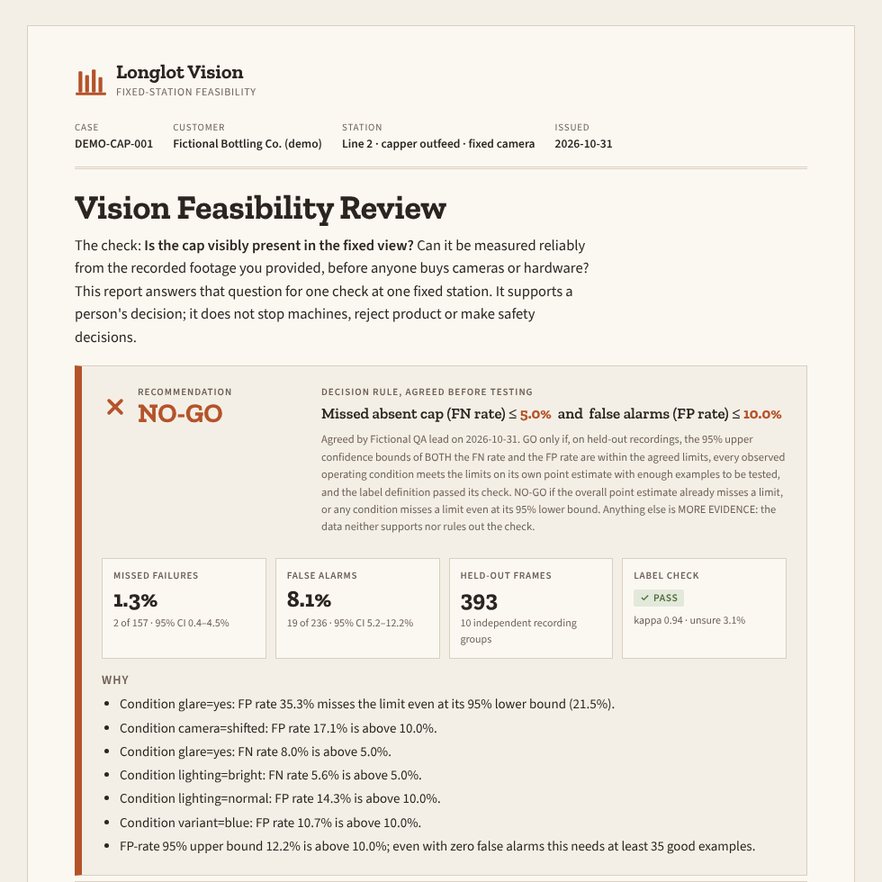
It ends in no-go, which is the point: the decision rule was agreed first, the footage didn't meet it under glare and a shifted camera, and the report says so.

First page of the fictional sample report: a no-go recommendation for whether a bottle cap is visibly present, with the decision rule agreed before testing, missed-failure and false-alarm rates, and the conditions that missed the limits.
Page one of the fictional sample: Fictional Bottling Co., capper outfeed.

Bring one fixed station.

Tell me the station, the part or label someone checks there, and what footage exists. The twenty-minute call settles whether the question is narrow enough to test.

Before cameras, before implementation.
The review comes first and can end with no-go. Nothing is bought on the strength of a promise.

Or write directly:

saman@vanguardontario.ca